> For the complete documentation index, see [llms.txt](https://docs.sealsecurity.io/llms.txt). Markdown versions of documentation pages are available by appending `.md` to page URLs; this page is available as [Markdown](https://docs.sealsecurity.io/discovering/repository-page/sealed-packages.md).

# Browsing sealed packages

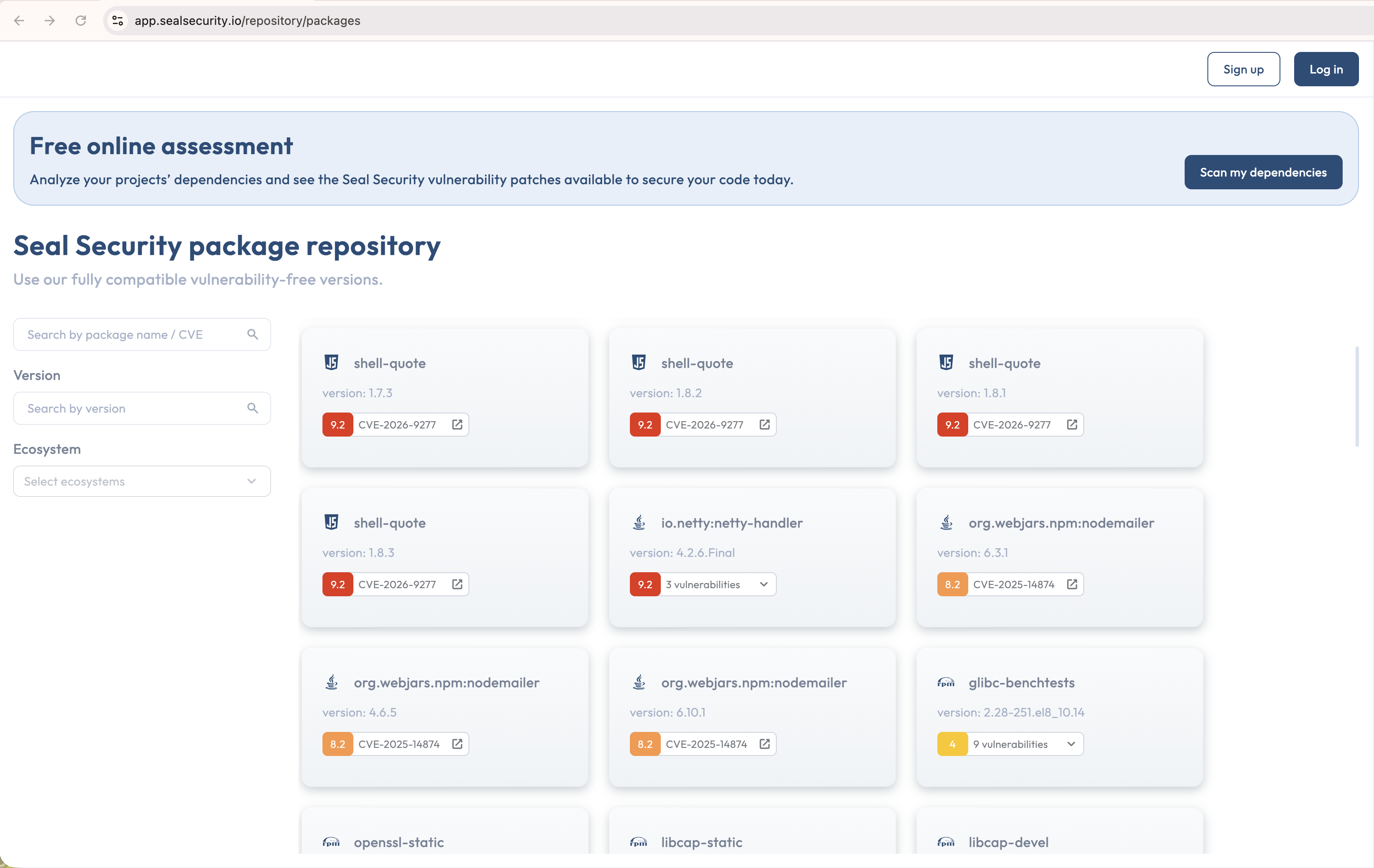
The public catalog at [`https://app.sealsecurity.io/repository/packages`](https://app.sealsecurity.io/repository/packages) lists every sealed package Seal has built. Browsing requires no account.

## The grid

<figure><img src="/files/hRIXOoeuR5lAI7GSpMuR" alt="The public sealed packages catalog grid with the filter sidebar"><figcaption><p>The public catalog of sealed packages, with cards showing ecosystem, version, and severity chips.</p></figcaption></figure>

Each sealed package is a card in an infinite-scroll grid. Each card shows the package name with the ecosystem icon, the package version, and vulnerability chips color-coded by severity that summarize the vulnerabilities the sealed version remediates relative to its origin version.

A search-and-filter sidebar narrows the grid by package name or CVE, by version (prefix match), and by ecosystem.

## Per-package detail

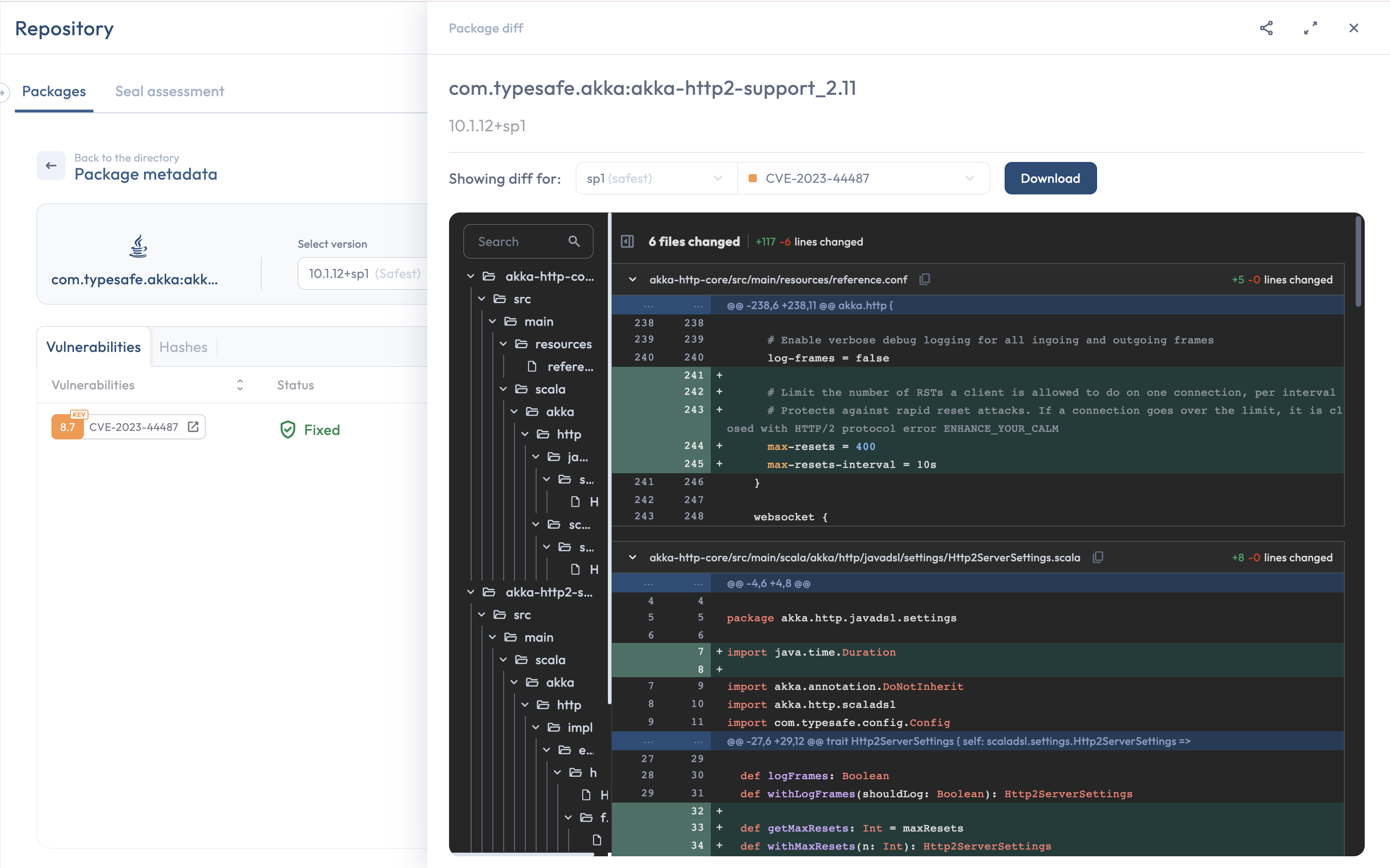
<figure><img src="/files/yvfK5RvMYEpxbJfQ6EFa" alt="A per-package detail page with the code-diff side drawer and Share button"><figcaption><p>The per-package detail page shows Vulnerabilities and Hashes tabs; the code-diff drawer has a Share button that copies a public link.</p></figcaption></figure>

Clicking a card opens a detail page for that exact `package@version` combination. The detail page has two tabs:

* **Vulnerabilities**: the table of vulnerabilities affecting the origin version, with severity, status (sealed by Seal or open), and links to the upstream advisory. The same model as the [The package drawer](/discovering/package-drawer.md) drawer in your tenant, just for the public catalog.
* **Hashes**: the cryptographic hashes of the sealed artifacts (the JAR, wheel, tarball, etc.) for verification.

A side drawer on the same page shows the per-vulnerability [code diff](/trust/code-diff.md) between the sealed version and its origin version. The diff covers every change Seal made to remediate the vulnerability: the patch itself, plus the dedicated tests Seal added to confirm the patch is effective. The tests are backported alongside the patch so the proof of remediation lives in the same artifact.

## Sharing a code diff

The code-diff drawer has a **Share** button that copies a public link to the same diff. The link works without authentication; you can paste it into an email, a ticket, or a chat without granting access to anything else in your tenant.

The two common reasons to share a diff:

* An auditor wants to verify that a specific vulnerability was actually addressed in code, not just label-changed.
* A downstream customer wants to verify that the package shipped in your product no longer carries the vulnerability they flagged.

The shared link points at a real, public, verifiable artifact: the patch and its tests. There is no need to share screenshots, internal tooling outputs, or paraphrased descriptions.

## Related

* [The package drawer](/discovering/package-drawer.md): the per-vulnerability content equivalent inside an authenticated tenant.
* [Code diff](/trust/code-diff.md): the canonical home for what the side drawer shows.
* [Free assessment](/discovering/repository-page/free-assessment.md): upload your manifest and get back the sealed-coverage answer for every package in it.