> For the complete documentation index, see [llms.txt](https://docs.sealsecurity.io/llms.txt). Markdown versions of documentation pages are available by appending `.md` to page URLs; this page is available as [Markdown](https://docs.sealsecurity.io/discovering/generate-fix.md).

# Triggering Generate fix

**Generate fix** is the action that asks Seal to build a sealed version of a specific package and version on demand. It is the path out of the [Generate available](/discovering/package-states.md#generate-available) state: until you trigger it, the row sits there waiting.

## Before you start

* You have the **Admin**, **Sealer**, or **Collaborator** [role](/getting-started/users-and-sso/user-roles.md). Watchers cannot trigger Generate fix.
* The package is in the **Generate available** state on the [Vulnerable packages tab](/discovering/protection-page/vulnerable-packages-tab.md). If the row is **Unfixable** instead, Generate fix has already been determined to not apply (see the [Unfixable section](/discovering/package-states.md#unfixable) for why).

{% hint style="info" %}
**Generate fix counts against your package quota.** Each Generate fix request commits Seal to backporting, building, and testing a sealed version, and the resulting package is recorded against your tenant's package usage on the [Usage page](/using-platform/usage-page.md), regardless of whether you go on to deploy it.
{% endhint %}

## Steps

<figure><img src="/files/bJK9FOzDhsrfsfgy0NDx" alt="Vulnerable packages tab with the Availability filter open and a Generate fix button on a row"><figcaption><p>Filter by Availability > Generate fix to find candidates; the Generate fix button sits in the row's action column.</p></figcaption></figure>

1. Open the **Protection** page and the **Vulnerable packages** tab.
2. Find the package you want a sealed version for. Filter by **Availability > Generate fix** to narrow to just the candidates.
3. Click **Generate fix** in the row's action column.
4. Confirm the dialog: **"Are you sure you want to request a sealed version for `<package>` version `<version>`?"**

The package's state changes to **Version in progress** immediately. A toast confirms the build was queued.

## What happens next

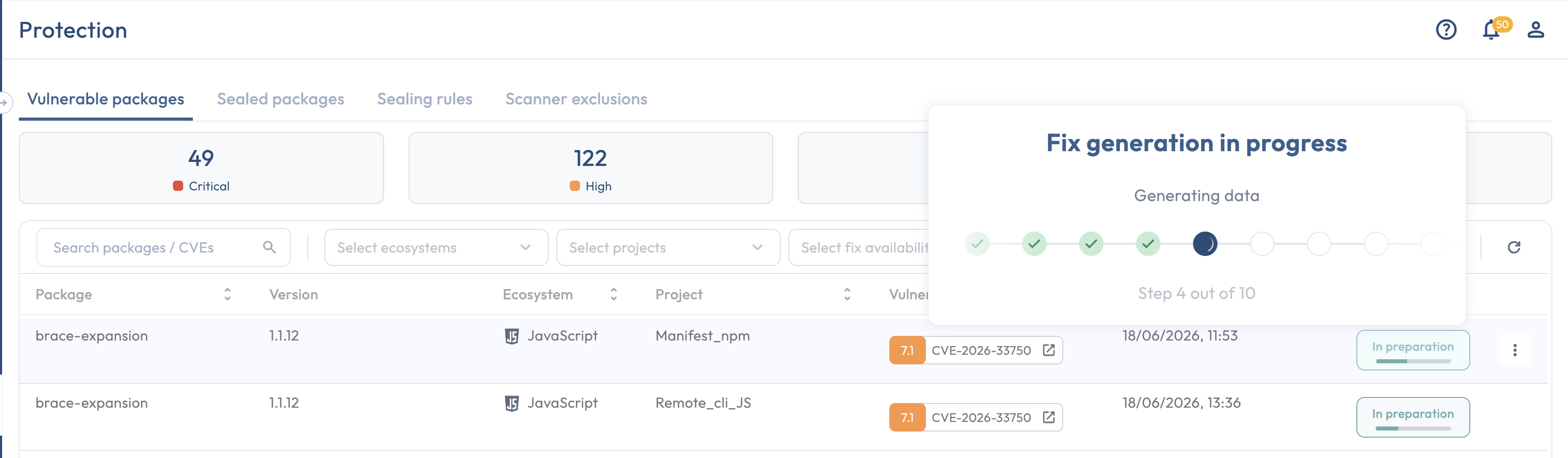
<figure><img src="/files/pSkEwiGG8SdKZzhUbCvZ" alt="A row in the Version in progress state with a progress indicator"><figcaption><p>The row immediately switches to Version in progress with a progress indicator while the sealed version is being built.</p></figcaption></figure>

A typical Generate fix build takes **24-72 hours**. While it runs, the row shows a progress indicator instead of the action button. When the build finishes, the state changes to:

* **Ready to seal** if the build succeeded. The sealed version is now in Seal's catalog.
* **Pending deploy** if the build succeeded **and** a matching Sealing Rule already exists, or **and** the Seal Project uses the Automatic Remediation deployment method. The next CLI run will apply the fix.
* **Unfixable** if the build failed. This is rare. See [Unfixable](/discovering/package-states.md#unfixable) for the reasons.

Once a sealed version is in the catalog, it is available across your tenant. Other Seal Projects that contain the same vulnerable package and version pick it up: their rows move from Generate available to Ready to seal as Seal next reconciles the discovery signal.

## Troubleshooting

**The Generate fix button is disabled.** Either the package is already in the **Unfixable** state (the tooltip on the disabled button says *"There is no feasible fix at the moment"*), or your role does not include the GENERATE\_FIX permission.

**The Generate fix button is missing entirely.** The package has been flagged as malicious. The action column shows a red **Malicious** badge instead. Malicious packages have no sealed counterpart; remove the package from your dependencies.

**The build has been running for more than 72 hours.** Contact your Seal account team. They can check the build's progress and either explain the delay or escalate.

**The state moved to Unfixable.** A Generate fix build failure is rare. See [Unfixable](/discovering/package-states.md#unfixable) for the three reasons a row can land there and what to do for each.

## Related

* [Package states](/discovering/package-states.md): the canonical reference for the six states, including the transitions Generate fix drives.
* [The Vulnerable packages tab](/discovering/protection-page/vulnerable-packages-tab.md): where Generate fix is triggered.
* [Sealing Rules](/using-platform/sealing-rules.md): the next step after a successful Generate fix in the Remote and Local deployment methods.